
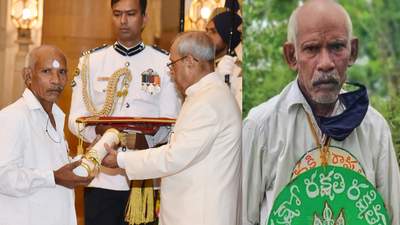
On the dry roads of Telangana’s Khammam district, people grew used to a small but stubborn sight: a man on a bicycle, pockets heavy with seeds, determined to leave every barren patch a little less lonely than he found it.
That man was Daripalli Ramaiah, better known locally as Chettu Ramaiah or Vanajeevi Ramaiah, and his life turned into one of those rare stories that feels almost too simple to be true until you look closer and realize it was built one sapling at a time. Scroll down to read more…
The pocket-sized revolution
Ramaiah did not arrive with a grand campaign or a glossy slogan. He arrived with seeds. According to reports, he carried them in his pocket and planted them wherever he found open, dry ground, often while riding his cycle through the region.
He was not obsessed with counting for the sake of numbers; in fact, he reportedly never kept a precise record of how many saplings he planted. Still, by his own modest estimate, the total crossed ten million over the course of his life.
That is not just a statistic. It is a landscape changing shape in slow motion.
A lesson he never forgot
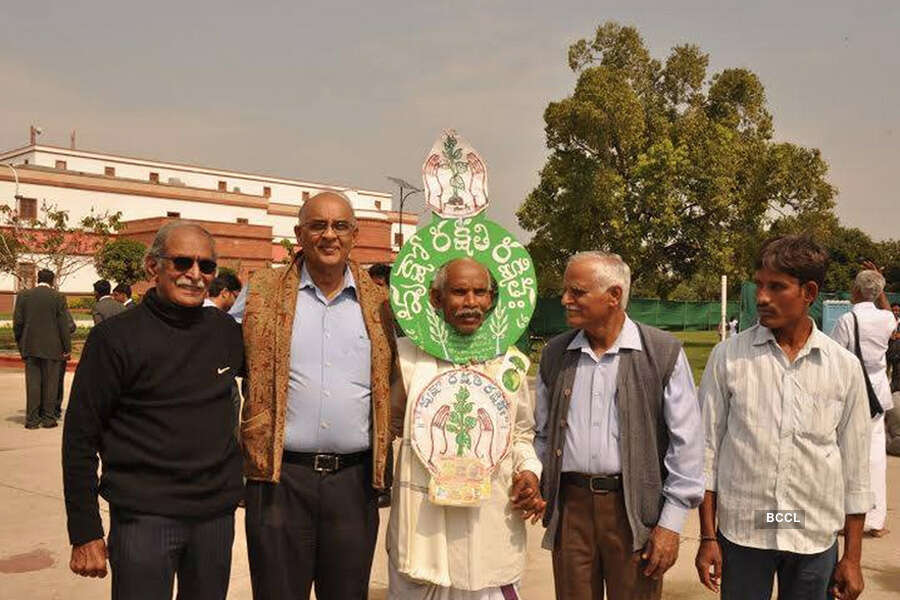
Daripalli Ramaiah is a man on mission toplant trees and bring back the green cover. According to the reports, he hasplanted lakhs of trees.
The roots of Ramaiah’s mission go back to something beautifully ordinary: his mother saving seeds for the next planting season.
That memory stayed with him, and he carried it into adulthood as a kind of private instruction manual. Reports say he studied tree planting through reading, clipped articles about trees, and turned his home into a kind of living archive of slogans and notes on conservation. Even after leaving school after class ten, he kept learning in the field, from the soil, from observation, and from repetition, the patient kind that builds expertise without ever announcing itself.
More than planting, a habit of insistence
What made Ramaiah unusual was not only that he planted trees, but that he treated the act like a daily obligation. He would travel to barren stretches, sow seeds along roads and canal banks, and focus on native species and useful trees that could offer shade, fruit, or long-term ecological value. One report describes his early work along a four-kilometre stretch near Khammam, where he began greening the sides of the road and canal banks with native seeds.
That kind of work does not make a dramatic sound. It just keeps going until people begin to notice that the air is different.
The man society underestimated
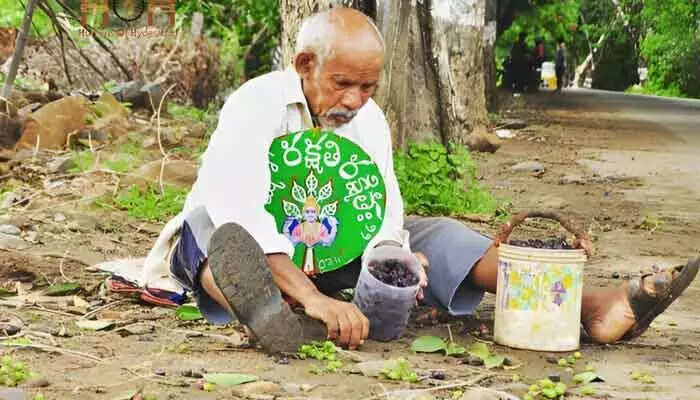
Like many people who spend their lives doing practical good, Ramaiah was not always immediately understood. One report notes that he was once mocked as mentally unstable for his obsession with planting saplings. That detail says as much about public impatience as it does about him. He did not seem to mind the laughter.
He kept pedaling, kept planting, and even turned his own home into a place where tree-plantation slogans were displayed like reminders to the neighborhood that conservation is not a theory, it is a habit.
His family also supported the work, and his household became part of the mission rather than standing outside it.
Recognition came, but later than the trees
For years, Ramaiah’s work moved quietly through Telangana before the country began to give it the formal attention it deserved. The Government of India named him in the Padma Shri list for the year two thousand seventeen, and his name also appears in official award records under social work in Telangana.
Earlier recognitions included the Seva Award, the Vanamitra Award, and the National Innovations and Outstanding Traditional Knowledge Award in two thousand fifteen. Even then, the honors felt less like a finish line and more like a public acknowledgment of something that had already been happening for decades.
Why his story still matters
Ramaiah’s story lingers because it is built on a kind of courage that does not age badly. He sold land to buy saplings and seeds, kept planting even when the applause was absent, and treated greenery as a responsibility rather than a campaign.
Reports in twenty twenty-five noted his death in Khammam at the age of eighty-seven, and the tributes that followed reflected the scale of his influence: a green crusader had gone, but the living result of his work remained visible in the trees, shade, and memory he left behind.
The quiet kind of heroism
There is something deeply moving about a life that does not need to shout to be remembered. Ramaiah did not build monuments. He built cover, canopy, and continuity. He made the idea of restoration feel personal, even intimate, as if one person’s pocketful of seeds could argue with drought and win. That is why his story stays with you. It is not only about a man who planted millions of trees. It is about a man who understood, long before most people did, that the future can begin with something as small as a seed and as ordinary as a bicycle ride.