
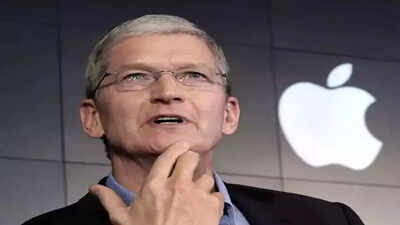
The photo Apple put out with the announcement was doing a lot of work. Tim Cook and John Ternus, walking side by side through Apple Park. Both in dark button-up shirts. Both in blue jeans. Both wearing Apple Watches.
Smiling at each other like two people who’ve spent years in the same building and genuinely don’t mind it.The message was obvious: nothing is ending, something is beginning, and the distance between the two is smaller than you think. What the photo didn’t say—what transition photos never say—is that the person walking out of frame spent 15 years building something nobody thought he could build, in a way nobody thought to look for.
And the person walking into frame is inheriting a company that is, simultaneously, the strongest it has ever been financially and the most curious about what it does next.That’s the actual story. Not the org chart changes. Not who reports to whom come September. The story is that Tim Cook made running Apple look easy for a very long time, and John Ternus is about to find out what hard looks like from the top floor.
Nobody thought he had more than a few years
Cook became CEO in August 2011. Jobs died six weeks later. The outside world, watching both happen in quick succession, reached the obvious conclusion.
“The problem, really at the core,” one analyst told The New York Times at the time, “is that Steve Jobs’s inspiration is irreplaceable.” Reasonable thing to say in October 2011. Sounds different now, from the other side of $4 trillion.The doubt made sense. Jobs was the showman, the taste-maker, the person who understood what people wanted before they’d figured it out themselves. The iPod, the iPhone, the iPad—products that didn’t just sell but rewrote the rules.
Cook was none of that. He came from IBM, spent time at Compaq, and was recruited in 1998 specifically because Apple’s supply chain was a mess and he was good at fixing those. He fixed it. That was his job.
He was exceptional at it.What nobody accounted for was what Cook would do once he actually had the top job.He didn’t try to be Jobs. Didn’t hold the theatrical product reveals. Didn’t cultivate the mythology. He showed up as himself—precise, methodical, interpersonally careful—and started building.
Apple went from $350 billion to $4 trillion. Revenue nearly quadrupled. Annual profit grew more than eightfold. The installed base crossed 2.5 billion devices. The company became the first to hit $1 trillion in market cap, then $2 trillion, $3 trillion, $4 trillion.
Cook ran it through a pandemic, two Trump administrations, multiple trade wars, and the biggest platform shift in computing since the iPhone itself.
He did all of this while wearing essentially the same outfit every day and waking up before 5am to read customer emails—every day, for 15 years.The stewardship critique has followed him throughout: that he rode Jobs’ coat-tails, that Apple’s trajectory was already locked in, that any competent operator would have done the same. It’s the kind of argument that sounds reasonable until you look at what he actually built.Cook didn’t invent the iPhone. But he understood what it was in a way that completely changed the company’s shape. The iPhone wasn’t just a product—it was a platform. And platforms, if you build the right things around them, compound in ways that are very hard to stop. The infrastructure Cook constructed—the App Store, iCloud, Apple Pay, Apple Music, Apple TV—turned a hardware company with a great flagship into a recurring revenue machine.
Services now clear $100 billion a year. None of that existed under Jobs. That’s Cook’s, entirely.He also made the chip call. In 2020, Apple started pulling Intel processors out of its Macs and replacing them with its own Apple Silicon. Faster machines, better battery life, a Mac lineup that suddenly felt worth talking about again. That decision is still paying off. The MacBook Neo—a $599 laptop Ternus launched recently, running on a chip descended from the iPhone—sold out almost immediately.
A Cook-era call, landing now, with someone else’s name on the press release.
That’s the long game working exactly as intended.
The part of the job nobody writes about
Apple makes roughly 80 percent of its iPhones in China. Cook inherited that dependency and spent 15 years managing it through conditions that would have broken most supply chains—trade wars, a pandemic that shut Foxconn’s Zhengzhou plants, and a US-China relationship that went from complicated to structurally adversarial without ever quite stabilising.The supply chain held through all of it, which sounds simple and wasn’t.Cook’s approach was personal in a way that’s unusual at that level. He visited China consistently. He built relationships with government officials and factory leadership alike, understanding that in China the relationships and the business are the same thing. He met Xi Jinping multiple times. He maintained all of it across every political season, on both sides of the Pacific.When Trump’s 2025 tariffs sent Apple’s stock down more than 20% in days, Cook’s response was practiced and effective. He pledged $600 billion in US investment over four years, stood next to Trump in the Oval Office, and walked Apple out largely exempt from the tariffs that landed hard on the rest of the industry. Apple’s supply chain stayed intact, its pricing held, its customers felt nothing.It made Cook something unusual in corporate America: an executive with genuine diplomatic standing.
Trump took his calls. China’s leadership viewed him as a consistent presence. When Cook moves to executive chairman, Apple has specifically said his role will include engaging with policymakers globally. This is not a ceremonial arrangement. These relationships took 15 years to build. The company isn’t letting them go.Ternus gets the CEO title. Cook keeps doing the work that, right now, only Cook can do.
The road map everyone is underestimating
Apple announced Apple Intelligence in 2024. The positioning was deliberate: AI that lives on your device, runs on your chip, handles your data privately, and plugs into software you already use—rather than arriving as a separate thing you have to remember to open.
While the rest of the industry was racing to ship AI features as fast as the models allowed, Apple was thinking about how AI actually fits into an ecosystem.
How it connects to the hardware. How it feels like something Apple made rather than something bolted on.Some features came before others. The full Siri overhaul is still on the way. The rollout has been gradual in a way that frustrated people expecting Apple to match OpenAI’s pace.
But the underlying argument—on-device AI running on Apple Silicon, with the privacy architecture the company has spent years building—is more coherent than impatient coverage of it suggests. When it comes together fully, it won’t look like anyone else’s product.
That’s the point.Ternus has already started restructuring for this. The hardware engineering division has been reorganised around what he describes as an AI platform—not a feature set, a foundation.
The signal is clear: AI isn’t being added to Apple’s products. It’s what the next generation of products is being built around.The pipeline that comes with it is, by internal accounts, the most genuinely exciting Apple has had in years. A foldable iPhone this fall—one of the most significant hardware changes in the device’s history, and Ternus’ first real product moment as CEO. Smart glasses, a pendant device with cameras, new AirPods with computer vision.
A smart home display with facial recognition, a tabletop robot with a swivelling screen, a security camera.
These aren’t updates. They’re new categories, arriving at a moment when Apple’s silicon is world-class and its software platform is finally maturing to meet it.Some timelines have shifted. Smart glasses moved from 2025 to possibly 2027. The tabletop robot from 2027 to potentially 2028. Apple products tend to be better for the wait—that’s a 25-year pattern, not a rationalisation.
And the company has more resources to execute on all of it than it has ever had.
The guy who actually knows how Apple works
Ternus joined Apple in 2001. Mid-twenties, product design team, fresh from a virtual reality startup nobody remembers. His entire professional adult life has been inside one company. He knows which teams actually ship, which ones are good at looking like they will, and where the real decisions get made versus where they get announced.People who’ve worked with him describe him the same way, almost without variation: direct, focused, genuinely nice.
Someone who goes straight to the engineers who understand the product rather than the managers who understand the presentation. He races his Porsche at Laguna Seca on weekends and reportedly clocks a lap in under 1:40—a small detail that says something accurate about how he thinks about speed and precision at the same time.The thing that defines how Ternus operates, according to people close to him, is that he makes decisions.
That sounds like the minimum requirement for a CEO. At Cook’s Apple, the culture ran on consensus—collaborative, careful, deliberate, built around a leadership team that moved together. It worked extremely well for a long time. One colleague told Bloomberg’s Mark Gurman that bringing Cook a choice between A and B typically produced a series of questions rather than a pick.
Ternus picks. The company moves.That shift matters more right now than it would have five years ago.
The AI features, the new hardware categories, the Siri rebuild—these need speed. Speed is easier when someone at the top will make the call and own the outcome.He’d been quietly absorbing more of the company for months before the announcement anyway. Executive sponsor of the design team. Control over Apple Watch hardware engineering. The robotics team moved under him. Cook was transitioning the company before the title changed—which says something about how long this had been planned and how ready Ternus actually is.At the all-hands in the Steve Jobs Theater the morning after the announcement, he told employees Apple was “about to change the world once again.” Said it was the most exciting time in his career to be building products. People who know him say he meant it—that the energy was real, not performed. After Cook’s careful and measured public presence for 15 years, that might count for more than it sounds, particularly for a company that needs its people to move fast on genuinely hard problems.Cook isn’t disappearing. As executive chairman, he’ll keep doing the geopolitical work—the US-China relationship, Washington, the policymaker engagement that took 15 years to build and that Ternus, by most accounts, isn’t yet ready to take over. Cook said at the all-hands that he’s healthy, his energy is high, and he plans to stay in the role for a long time. He also said, plainly, there can only be one CEO at a time. The division is clean.The succession itself unfolded the way Cook said he always wanted. No drama, no rushed timeline. He described waiting for three things to align: the business strong, the road map in great shape, the successor genuinely ready. He said all three converged now. The handoff was exactly what he said he wanted—clean enough to end up in a business school case study, which he also said he hoped it would.Jobs told Cook at the end: don’t ask what I would do. Just do the right thing.
Cook passed the same line to Ternus. Jobs had watched Disney freeze after Walt died—so consumed with what Walt would have wanted that it couldn’t figure out what it wanted itself. Cook spent 15 years proving he’d taken that seriously. He never tried to be Jobs. Didn’t perform the theatrics or dress for the mythology. He showed up as Tim Cook, built what Tim Cook could build, and it turned out to be more than enough.Ternus gets the same blank page. Not Jobs, not Cook. A mechanical engineer who’s spent 25 years inside one company, knows the hardware at a level most CEOs never approach, makes decisions, and is walking into the most exciting product pipeline Apple has had in a long time.The balance sheet is strong. The silicon is world-class. The installed base is 2.5 billion devices. The road map is full.Cook believed tomorrow is better than today and built his whole life around it. Grew up in Robertsdale, Alabama, neither parent went to college, and ran the most valuable company in history. Hard to argue with the philosophy.Ternus is 50. He has the company, the road map, and the runway. The next part is his.