
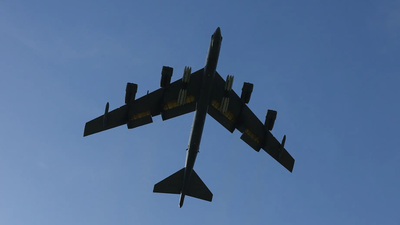
A USAF B-52 Stratofortress bomber, which is loaded with munitions, flies from RAF Fairford airbase in Fairford, UK, April 7, 2026.
US President Donald Trump has threatened to destroy Iran’s power infrastructure and bridges. The threat is in response to the prolonged closure of the critical Straits of Hormuz, through which roughly 20% of the world’s oil passes.
The closure of this critical waterway has sent oil prices rising across the globe. The American and Israeli coalition has so far focused on destroying and degrading Iran’s military capabilities. Over 3,500 people have been killed in Iran so far, including at least 244 children.The targeting of power infrastructure is a low-hanging fruit as it causes disproportionate damage, while at the same time minimising civilian casualties.
The destruction of the electricity infrastructure has cascading effects. These effects range from hampering the ability of the military, reducing output of both military as well as civilian industrial complexes and hampering communication systems.Electric power is key for the functioning of energy-hungry radars and is also a critical requirement for communication systems on which most militaries depend.
The hampering of effective communications can increase the density of the proverbial fog of war in the adversary’s camp and will hamper the leadership in taking timely and effective decisions. As these key military systems are to be given priority during a conflict, this would mean that the limited electricity available would be directed to the defence apparatus.Attacks on power infrastructure do not show immediate results and are carried out in order to degrade the enemy’s ability to fight in the medium to long term.
This probably hints at the fact that the United States perhaps expects this conflict to last longer than initially planned.The lack of electricity could also adversely affect morale on the home front and lead to widespread discontent, which may spill onto the streets. The Iranian regime recently saw widespread protests, which the government countered with a bloody reprisal, resulting in the deaths of over 30,000 civilians.There is a long history of attacks on power infrastructure. One of the first such missions, the destruction of two dams in the German industrial heartland during the second world war, became one of the most famous air raids of that conflict when 617 Squadron of the Royal Air Force, the famous ‘Dam Busters’, earned their name and their place in history due to this operation.Attacks on electric infrastructure were also carried out in the Korean War, the Vietnam War, Operation Desert Storm, the 2003 invasion of Iraq and during the ongoing Russian invasion of Ukraine.
It is, in fact, becoming a regular affair. In the last week, Iranians also caused power outages in Israel after missile debris hit the power infrastructure in Hadera.India also struck Pakistani energy infrastructure during the 1971 war. The 20th Squadron of the Indian Air Force, popularly known as the Lightnings, hit the Attock oil refinery, deep inside enemy territory, almost midway between Peshawar and Islamabad. The aim of the operation was to cripple the flow of fuel throughout Pakistan.
The Pakistanis suffered prolonged fuel crisis that outlasted the war. The flames of the fire were so bright that they were used as a navigation aid for high-flying Canberra bombers during their nightly raids on the Peshawar airfield for many days to come.The Indian Navy also destroyed Pakistani fuel storage facilities at the Karachi port and the Kaemari oil farm in the city. The Indian Air Force bombed another oil refinery in Karachi.
Pakistan’s city of lights was hard-pressed to put out the fire, which could be seen from miles away.The United States has developed specific non-lethal weaponry to destroy electric infrastructure in the form of the BLU-114/B, popularly known as the Graphite bomb. Both South Korea and China have also developed similar weapons. Iran produces 100 gigawatts of electricity through a vast network of power plants spread across the country.
This is one-fifth of India’s installed capacity. Most of Iran’s electricity is generated by gas-fueled power plants. Targeting these plants or the pipelines feeding them would not be difficult now, especially as the Israeli-American coalition now controls the air and has already hit nearly fifteen thousand targets.The targeting of power infrastructure in this case may also signal reciprocity as it is said to be carried out in response to the closure of the Strait of Hormuz. Regardless of the motive behind this warning to send Iran back to the proverbial dark ages. The process of restoring the Iranian power grid could take years in the worst-case scenario, increasing the suffering of the average Iranian. The Trump administration has repeatedly stated that the current conflict is against the regime and not against the people of Iran.
If the Americans do strike these power stations, then there is a good chance that the average Iranian would see Washington’s claims and intentions differently.