
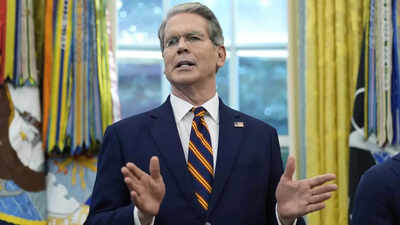
United States Treasury Secretary Scott Bessent
US Treasury Secretary Scott Bessent announced that the US government has seized $344 million in cryptocurrency assets over ties to Iran. The Treasury Department “will continue to systematically degrade Tehran’s ability to generate, move, and repatriate funds,” Bessent said in a statement on X (formerly known as Twitter).
He further stated that his agency was imposing sanctions on “multiple wallets tied to Iran,” resulting in the freeze of funds. According to a report by AFP, the move comes as Washington seeks to raise pressure on Tehran amid energy supply disruptions due to war in the Middle East.The report quotes an US official who spoke with the agency on condition of anonymity. The official said that Washington is targeting both typical sanctions evasion means like front companies, alongside newer technologies like digital assets.
The official further added that the Treasury is in active dialogue with financial institutions including digital assets exchanges.
Iran’s IRGC threatens to cut undersea internet cables in Persian Gulf
Iranian news agency recently reported that the Iran’s Revolutionary Guard (IRGC) issued a warning, suggesting that the undersea data cables running through the Strait of Hormuz are highly vulnerable to accidental or deliberate action. The report, published Wednesday by the Tasnim news agency, cautioned that “simultaneous damage to several major cables” may trigger outages across the Persian Gulf.
“Simultaneous damage to several major cables — whether through accidents or deliberate action — could trigger severe outages across the Persian Gulf,” the agency said.The Strait of Hormuz is famously known as one of the world’s most important oil chokepoint as well as a vital digital artery due to the presence of a dense web of fiber-optic cables beneath its waters that serve as the backbone for global communication.
If these cables snap, the impact would be felt far beyond the Middle East.This is because these lines carry an estimated 17% to 30% of regional internet traffic, connecting Asia, Europe and the Middle East. Moreover, these cables power massive AI infrastructure hubs in the UAE and Saudi Arabia backed by tech giants like Amazon, Microsoft and Google.These cables are also central to global financial transactions and cloud services to daily emails and video calls relies on this underwater network.