
Robert Goddard’s 1926 launch of the first liquid-fueled rocket, though modest, marked a pivotal moment in rocketry. His foundational principles, including turbopumps and gimbaling engines, are now integral to NASA’s Artemis 2 mission, which will send astronauts around the moon, a testament to his enduring legacy.
On a quiet farm field in Massachusetts, a tall physics professor worked on a simple homemade rocket to be propelled by gasoline and liquid oxygen. On March 16, 1926, the machine briefly came to life, climbing just 41 feet before landing, and yet it marked a turning point in the history of rocket launches.Robert Goddard, the modest inventor behind it, started the era of modern rocketry with little notice. Critics laughed off his ideas about reaching the moon as foolish fantasies.But guess what?Now, about 100 years later, in March 2026, NASA‘s giant SLS rocket, which was built on Goddard’s key principles, moves to Launch Complex 39B, ready to send astronauts around the moon on Artemis 2.
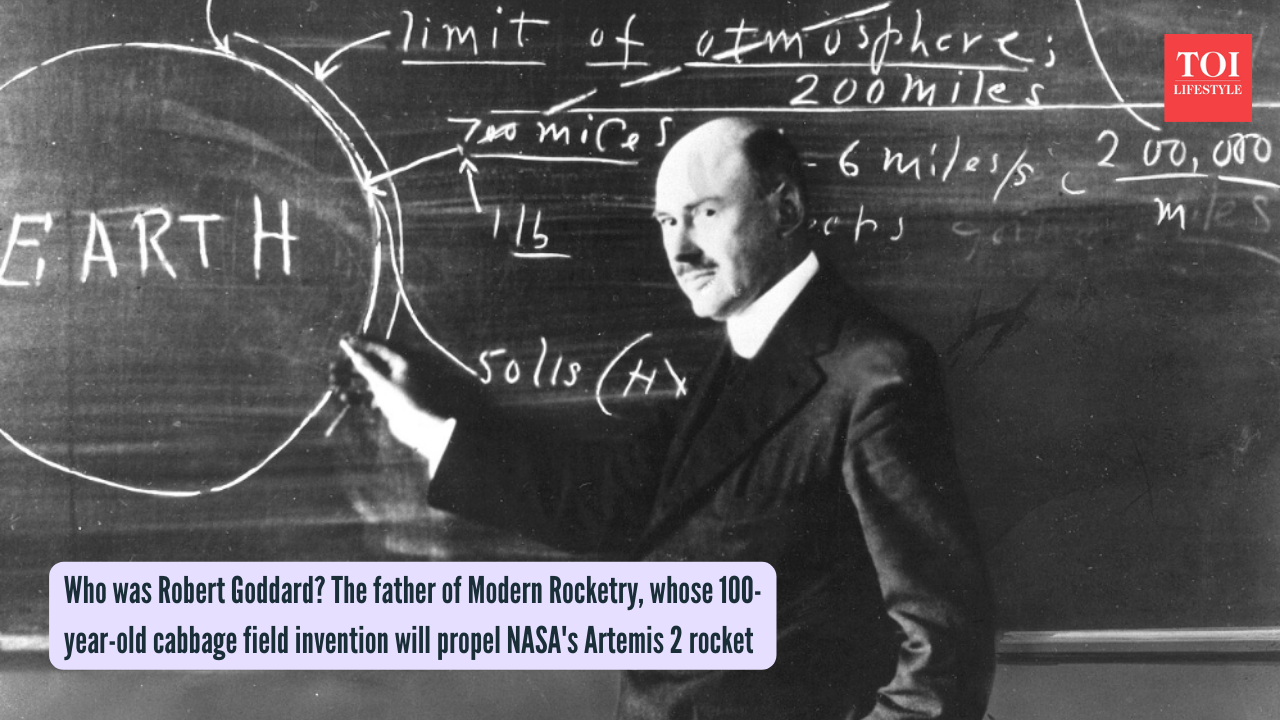
Who was Robert Goddard? The father of Modern Rocketry, whose 100-year-old cabbage field invention will propel NASA’s Artemis 2 rocket (Photo: Wikimedia Commons)
Meet Robert H Goddard
Exactly 100 years ago, on March 16, 1926, Robert H. Goddard launched the world’s first liquid-fueled rocket from a ‘cabbage patch’ in Auburn, Massachusetts.
The 10-foot-tall device, nicknamed “Nell,” burned gasoline and liquid oxygen, climbing 41 feet in 2.5 seconds before landing 184 feet away, according to NASA’s historical account.Witnesses included his wife, Esther, crew chief Henry Sachs, and Clark University colleague Percy Roope. Goddard’s diary captured the moment, “The first flight with a rocket using liquid propellants was made yesterday at Aunt Effie’s farm in Auburn,” as quoted in Wikipedia’s Goddard entry.
This short ‘hop’ proved liquid propellants could work, unlike “once-lit, fully-burned” solids. Goddard’s innovations, turbopumps, gimbaling engines, and gyro guidance, formed rocketry’s backbone, as per the National Air and Space Museum
He is called the ‘Father of Modern Rocketry .’
Hailed today as rocketry’s father, Goddard taught at Clark University and inspired NASA’s Goddard Space Flight Center in Maryland. His 1926 design changed the practice, placing the engine at the base for stability, says the Smithsonian.
Early ridicule faded as his patents fueled missiles, satellites, and Apollo’s moonshots less than 50 years later.Liquids beat solids by allowing throttle control and more oomph, as the fuel and oxidizer mix in a chamber, ignite, and blast out the nozzle. This principle lives on till date.
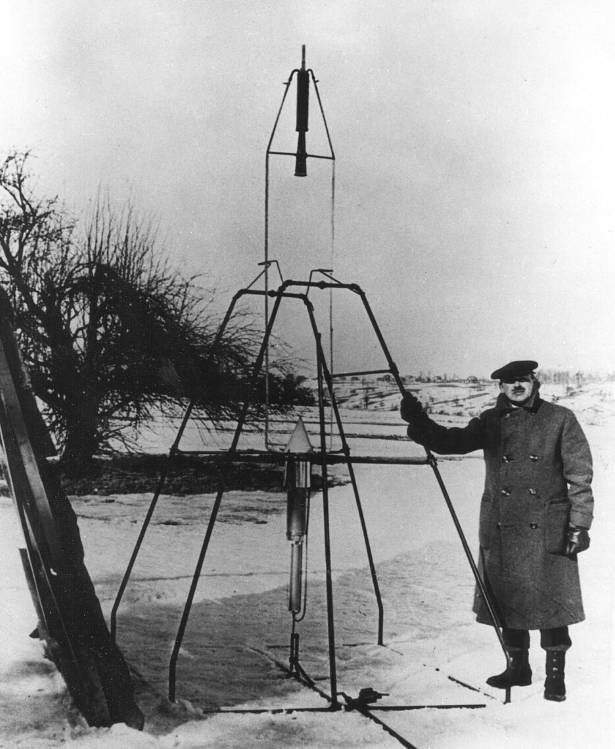
Robert Goddard, on March 16, 1926, holds the launching frame of his most notable invention—the first liquid-fueled rocket. (Photo: Wikimedia Commons)
Goddard’s principle is used in propelling Artemis 2
NASA’s SLS for Artemis 2, which is 30 times taller than Nell, uses the same liquid oxygen and fuel spark for liftoff, by using a combination of solids for boosters.Rolled to Kennedy Space Center’s pad on January 17, 2026, it shall be launched around the April 1-6 window. Artemis 2’s Orion will loop the moon with four astronauts, no landing, but testing life support for Artemis 3, which is set for 2027 docking, and Artemis 4 set for 2028 touchdown.