
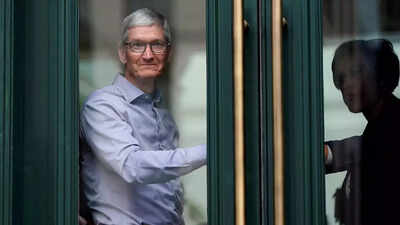
Tim Cook, after fifteen years of leading the one of the world’s most influential consumer tech giant, is officially stepping down as CEO of Apple. Cook, who famously succeeded co-founder Steve Jobs in 2011, will transition to the role of Executive Chairman, handing the reins to hardware chief John Ternus.
He leaves behind a company that has been fundamentally transformed, thanks to a line of successful products and remarkable numbers the company achieved under his leadership.Here is the story of his tenure, told through the numbers that defined it.
$3.66 Trillion: A decade of growth
When Cook took over in August 2011, Apple was valued at $350 billion. Today, its market cap sits at around $4 trillion. Under Cook’s watch, Apple’s value grew tenfold, making it larger than the entire economy of the UK, as per Bloomberg.
The ‘profit explosion’ at 699%
Despite global supply chain crises and a cooling smartphone market, Apple’s net income hit $112 billion in 2025. That is an 800% increase compared to the year before Cook took over – achieving this by shifting Apple’s focus toward “Services” (like the App Store and iCloud) and expanding the Apple ecosystem.
2.5 billion active devices
Apple now has an installed base of more than 2.5 billion active devices globally. He built a cohesive ecosystem that keeps users locked in with people purchasing products like the iPhones, Apple Watch, iPads, MacBooks, Mac PCs and more.
540 Apple Stores worldwide
Cook inherited a respected retail wing and expanded it by roughly 200 stores. Most notably, he conquered China, where Apple now operates 50 stores. This presence allowed Apple to thrive in the world’s biggest smartphone market.
The ‘New Normal’ for pricing
Under Tim Cook, Apple tested the “thousand-dollar boundary,” and successfully convinced consumers to pay premium prices for “Pro” versions. This strategy helped Apple survive chip shortages that crippled its competitors in 2025 and 2026.
15,000 metric tons: The green initiative
Cook made environmentalism a core part of Apple’s brand. By redesigning packaging, the company avoided 15,000 tons of plastic over five years, which is roughly the weight of 500 million water bottles. The latest MacBook Neo is the company’s greenest yet, with 60% recycled materials.
Apple’s ‘Spaceship’ Campus
Speaking of ‘Green’, the futuristic Apple Park headquarters was a dream of Steve Jobs, but Cook brought it to life in 2017. The massive 175-acre campus is powered entirely by renewable energy and serves as the iconic backdrop for the company’s famous product launch videos.
Apple Watch: Smartwatch supremacy
Launched in 2015, the Apple Watch was Cook’s first major new product line. By the end of 2025, it held a 32% global market share. In fact, Apple Watch market share has never been ‘second’ since its launch. The wearable anchored Apple’s move into the health and fitness sector, growing faster than any of its rivals.In that quarter, global smartwatch shipments rose 4% YoY in Q4 2025. Apple led shipments with 32% market share, followed by Huawei at 13%.
Moreover, among the top 5 brands, Apple recorded the fastest YoY growth at 15% and remained the shipment leader, as per Counterpoint Research data.
The ‘AirPods’ phenomenon
If Apple Watch was not enough, Apple launched AirPods in 2016. Within two years, they captured 60% of the truly wireless earbud market, according to Counterpoint Research’s Hearable Market Tracker for Q4 2018. They became a cultural phenomenon and a multi-billion dollar business in their own right.
M1: The chip independence
In 2020, Cook oversaw Apple moving from Intel with the launch of the M1 chip. By designing its own processors, Apple created MacBooks with record-breaking battery life (up to 18 hours of video) and performance that forced the entire semiconductor industry to play catch-up.