

Many people take supplements but see little benefit because their bodies fail to absorb nutrients effectively.
A shelf full of vitamins, protein powders, and capsules. A routine followed with discipline. But, the expected energy, better skin, or improved strength never shows up.This is where the conversation needs to shift. The problem may not be what is being taken, but what the body is actually absorbing.
Because in nutrition, intake and absorption are not the same story.
The missing link: Absorption, not intake
Many people assume that swallowing a supplement means the body will use it. But the body is far more selective.Dr Sharad Malhotra, Senior Consultant & Director, Gastroenterology, Hepatology & Therapeutic Endoscopy, Aakash Healthcare, explains it simply, “Many people take supplements expecting quick results, but the real issue is often absorption, not intake.
For any nutrient to work, it must be properly absorbed in the gut, which depends on factors like digestive health, gut lining integrity, enzyme activity, and even the presence of other nutrients.
”The gut acts like a gatekeeper. If it is not functioning well, nutrients pass through without being used. So even a high-quality supplement can fail silently.
Your gut health quietly decides everything
The condition of the digestive system plays a central role. Inflammation in the gut, poor enzyme activity, or conditions like irritable bowel issues can reduce absorption significantly.
Chronic stress adds another layer. It slows digestion and disrupts the balance of gut bacteria. Overall, digestive disorders are rising in urban populations, and these directly impact nutrient absorption.This means the body may not be lacking supplements. It may be lacking the ability to process them.

Factors like gut health, nutrient pairing, stress, and supplement timing play a key role.
Nutrients need the right environment to work
Supplements do not work in isolation. They depend on other nutrients and conditions.Dr Malhotra explains, “For example, iron requires an acidic environment and vitamin C for optimal absorption, while fat-soluble vitamins like A, D, E, and K need dietary fats.”This is where many routines fail.A vitamin D capsule taken without any dietary fat may not absorb well. Iron taken with tea or coffee can lose effectiveness. The timing, pairing, and context matter just as much as the supplement itself.
When more becomes harmful
There is a common belief that higher doses bring faster results. That is not how the body works. Excess fat-soluble vitamins such as A, D, and E can build up in the body and become toxic over time.Dr Malhotra cautions, “It’s also important to understand that more is not always better. Excess supplementation can overwhelm the body and sometimes cause side effects.”Protein supplements are another example. While helpful in the right context, they can cause bloating, discomfort, and in some contaminated cases, even stress the liver and kidneys.The Food Safety and Standards Authority of India (FSSAI) has also flagged concerns about supplement quality and contamination risks.So the goal should never be “more,” but “right.”
The overlooked issue: Nutrient competition
Taking multiple supplements together may seem efficient. But it can backfire.Certain nutrients compete for absorption. Calcium can interfere with iron absorption. Zinc and copper can compete when taken in high doses together.Dr Malhotra highlights this clearly, “Taking multiple supplements together may lead to nutrient competition, reducing effectiveness.”This means that a well-intentioned routine can actually cancel itself out.
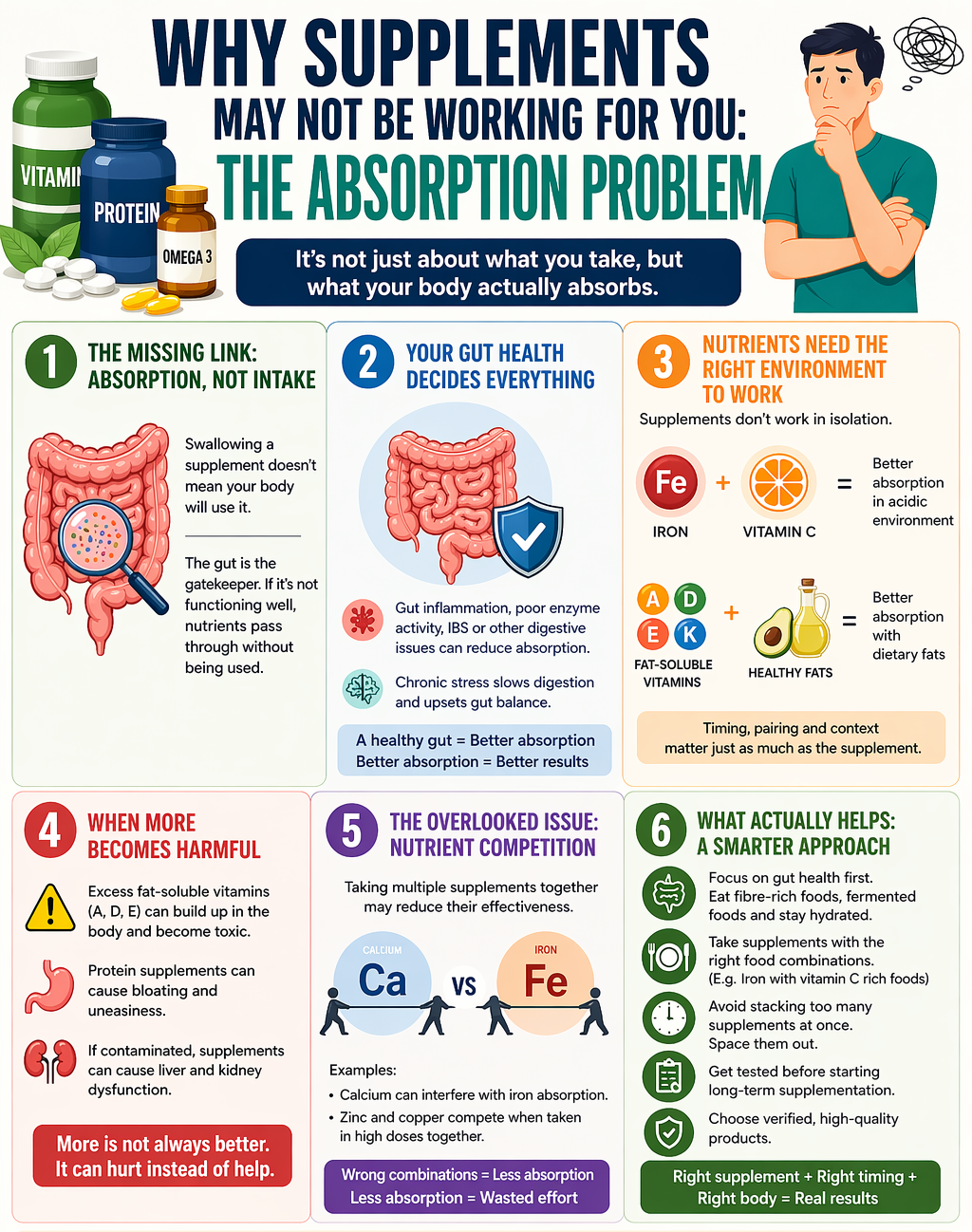
Excess intake can even be harmful. A targeted, evidence-based approach is the most effective way to make supplements work.
What actually helps: A smarter approach
The solution is not to abandon supplements. It is to use them more thoughtfully.A few changes can make a real difference:
- Focus on gut health first. A balanced diet with fibre and fermented foods supports absorption.
- Take supplements with the right food combinations. For example, pair iron with vitamin C-rich foods.
- Avoid stacking too many supplements at once. Space them out if needed.
- Get tested before starting long-term supplementation.
- Choose verified, high-quality products.
As Dr Malhotra notes, “A targeted, evidence-based approach, guided by proper diagnosis and timing of intake, is far more effective than blindly consuming supplements.”This approach may feel slower, but it works with the body, not against it.Supplements are often seen as shortcuts to better health. But the body does not respond to shortcuts. It responds to balance.Absorption is the quiet step that determines everything. Without it, even the best supplement routine becomes an expensive habit with little return.Understanding how the body uses nutrients can change the way health is approached. It moves the focus from “taking more” to “using better.”Medical experts consultedThis article includes expert inputs shared with TOI Health by:Dr Sharad Malhotra, Senior Consultant & Director, Gastroenterology, Hepatology & Therapeutic Endoscopy, Aakash Healthcare.Inputs were used to explain how supplements may not deliver expected benefits due to poor absorption, and to highlight the importance of proper usage and medical guidance before relying on or adjusting supplement intake.