
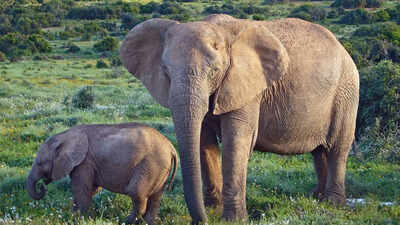
The African elephant population was traditionally reliant upon the ability to move around large areas in order to preserve high numbers of healthy individuals and genetic diversity.
Over countless centuries, the herds would migrate long distances to communicate with other herds and to exchange genetic material. However, scientific studies indicate that connectivity between elephant populations has declined sharply. A research, “Elephant genomes reveal a past of continental connectivity and a future of increasing isolation”, update from the University of Copenhagen highlights that elephants once maintained continent-wide genetic connectivity, but are now increasingly becoming isolated due to shrinking and fragmented habitats.This is an important ecological transformation, since the elephant herds have become isolated as a result of shrinking habitat ranges.
Study finds genetic divide growing among African elephant populations
A major genomic research, “The genomic impact of population connectivity and decline in Africa’s elephants,” published in Nature, examined elephant populations from various countries in Africa and observed an increasing trend of genetic differentiation. As revealed by the genomic analysis of the populations in question, although some populations continue to display genetic stability, others, especially the isolated ones, suffer from low genetic diversity.
Genetic diversity remains intact where the movement and interaction of populations are sustained. On the other hand, isolated populations have greater inbreeding rates and acquire more genetic mutations due to less gene flow.
Habitat fragmentation is limiting elephant movement
Isolation of elephants from each other is mainly caused by the phenomenon of habitat fragmentation. Activities like agricultural expansion, construction of roads and human settlement have led to the division of connected habitats into discrete fragments.
Such isolation hampers elephant movements and prevents them from coming into contact.This can be seen in northeast Africa, where elephants in Eritrea and Ethiopia are isolated several hundred kilometres away from any other groups in their own human-influenced environment.
Inbreeding and genetic risks threaten isolated populations
Genetic isolation has its biological impact. According to these studies, there is an increase in inbreeding among isolated elephant communities, and this poses a threat of deleterious genetic changes.
The effects of such changes would be a decline in immune function, a reduction in fertility rates, and a lack of population adaptability.Populations that remain genetically interconnected across greater landscapes retain their genetic diversity.
Differences between forest and savanna elephants in genetic diversity
The African elephant includes two different species: the Loxodonta cyclotis, commonly known as the forest elephant, and the Loxodonta africana, referred to as the savannah elephant.
Several studies suggest that the genetic diversity in forest elephants is usually greater than that of savannah elephants.In specific areas of West Africa, hybridisation between the two elephant species has contributed to maintaining genetic diversity. However, the hybridisation process itself presents challenges because it can include advantageous and disadvantageous genes.
Human activity continues to reshape elephant distribution
Factors that have influenced elephant distribution through human intervention include activities like poaching, deforestation and construction of infrastructure.
These human-induced factors have caused the elephants’ numbers to dwindle and made it difficult for them to migrate naturally.With less space and habitat, the animals are now forced to survive within enclosed areas where competition for food is high.
Connectivity remains essential for long-term survival
The discoveries made show that connecting elephant communities is vital for their continued existence. Elephants have an opportunity to mate with other groups when they can travel freely from one location to another. At the moment, it is vital to focus on ensuring that there are no obstacles to their movements in order to preserve migration corridors.