
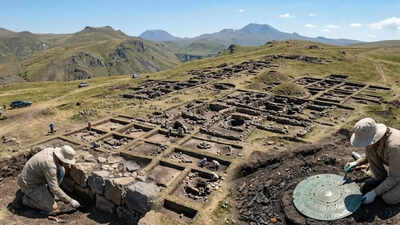
The rugged mountains in the southern highlands of Georgia have long been seen as a marginal region, disconnected from the broader developments that took place throughout Ancient South Caucasian civilisation.
However, through extensive research by the Samtskhe-Javakheti Project (begun in 2017), this perspective has been challenged. Archaeologists, using a combination of satellite imagery, GPS mapping and systematic fieldwork, have identified at least 168 sites on the Javakheti Plateau, as noted in a study by Cambridge University. These sites include diverse fortifications, burials and domestic buildings that demonstrate the complexity and integration of the culture and connect the culture more than previously thought.
Instead of being perceived as a barren and remote area, the southern highlands of Georgia are now seen as a vibrant cultural crossroads marked by the incredible resilience of humanity.
Archaeologists uncover 168 ancient sites in Georgia’s highlands
According to Cambridge University, through the use of advanced remote sensing and GPS analysis, the project was able to find settlement patterns, which proved the idea that there was some strategic spatial organisation, rather than them being randomly distributed.
The project showed that people were located strategically within these ancient communities on high ground for the purpose of being able to see other groups and create a sense of security.
In addition, the 168 sites’ massive stone structures, which are known as Cyclopean architectural structures, demonstrate the magnitude of work done to transform this rugged landscape. The archaeological finds suggest that there were groups of people who lived in these places seasonally or migratorily and returned to the same strategic places for several thousand years, which adaptively responded to changing environmental and social conditions.
This discovery unveiled the ritualistic roots of the highland past
They found several features of human habitation during excavations at Baraleti Natsargora (hill of ashes), characterised by distinct evidence of recurrent occupational fire events. The site has many different artefact layers dating between 3500 and 500 BCE. A notable artefact was the solar bronze disc that had several complex geometric decorative designs with perforations. Researchers have suggested that items like this one could have been used for ceremonial or religious purposes and that there was a continuous presence of rich culture for the highland populations connected to wider regional cultural beliefs.
Why this highland fortress was a cultural crossroads
The Meghreki Fortress provides an unparalleled view into continuous life in the highlands through evidence of continuous arrival through the Early Bronze Age to the medieval era and the discoveries of excavation that have identified both storage and living spaces and many unique clay installations, most of which undoubtedly were used as ovens, and many of which had their decorative tops adorned with plates that had incised geometric designs painted white, red, and dark blue.
The rare evidence of the painted colours of the decorated plates in the South Caucasus shows that Meghreki was not simply a remote defensive fortification but was an important cultural and social centre.