
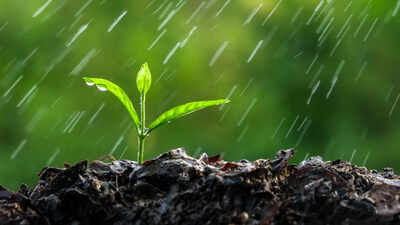
Picture this: you are napping on your couch, amid the scorching heat. Then you hear the soft patter of rain against your window. The sound gently pulls you awake. Now imagine being a tiny seed buried deep in the soil.
Darkness everywhere, and suddenly the gentle patter echoes – drip, drip, drip. Just like you, the seed seems to ask, ‘Is that rain?’ The seed soon murmurs, ‘Time to grow.’Well, this is not another AI video that you perhaps saw while doomscrolling. This could be reality. A groundbreaking study by Massachusetts Institute of Technology researchers found that plants can sense rain. The study’s findings are published in Scientific Reports.
Plants can sense the sound of rain
The MIT engineers found that some seeds may come alive to the sound of rain. The experiments they conducted on rice seeds showed that the sound of falling droplets effectively shook the seeds out of a dormant state. This sound of the rain stimulated them to germinate at a faster rate compared with seeds that were not exposed to the same sound vibrations. Interestingly, this is the first direct evidence that plant seeds and seedlings can sense sounds in nature.
“What this study is saying is that seeds can sense sound in ways that can help them survive. The energy of the rain sound is enough to accelerate a seed’s growth,” study author Nicholas Makris, a professor of mechanical engineering at MIT, said in a release.Makris and his co-author, Cadine Navarro, a former graduate student in MIT’s Department of Urban Studies and Planning, suspect that the pitter-patter may be similar to the vibrations generated by other natural phenomena such as wind.
The researchers are now planning to investigate other natural vibrations and sounds plants may perceive.
How plants respond
Plants are surprisingly perceptive. For survival, plants have evolved to sense and respond to stimuli in their surroundings. For instance, some plants snap shut when touched (touch-me-not plant). Some curl inward when exposed to toxic smells. Most plants respond to light; they reach towards its direction.
Interestingly, plants can also sense gravity.Makris, whose work focuses on acoustics across a range of disciplines, became curious when Navarro asked him questions about seeds and sound. They wanted to know whether the sound alone could shake the statoliths and help a seed grow. If so, what sounds in nature are enough to have such an effect.“I went back to look at work done by colleagues in the 1980s, who measured the sound of rain underwater.
If you check, you’ll see it’s much greater than in the air. It has to do with the fact that water is denser than air, so the same drop makes larger pressure waves underwater. So if you’re a seed that’s within a few centimetres of a raindrop’s impact, the kind of sound pressures that you would experience in water or in the ground are equivalent to what you’d be subject to within a few metres of a jet engine in the air,” Makris explained.As they suspected, rain-induced soundwaves might be enough to jostle statoliths and subsequently stimulate a seed’s growth.
What they found
To explore this idea, they conducted experiments with rice seeds. They carried out extensive experiments with roughly 8,000 rice seeds submerged in shallow water. They varied droplet sizes and heights to mimic light, moderate and heavy rainstorms. The researchers used hydrophones to measure the acoustic vibrations.They observed that the rice seeds exposed to the sound of water were able to germinate 30 to 40% faster than the seed groups that were not exposed to rain sounds. They also found that seeds closer to the surface could better sense the droplets’ sounds and grow faster, compared to more submerged or more distant seeds.“Brilliant research has been done around the world to reveal the mechanisms behind the ability of plants to sense gravity. Our study has shown that these same mechanisms seem to be providing plant seeds with a means of perceiving submergence depths in the soil or water that are beneficial to their survival by sensing the sound of rain. It gives new meaning to the fourth Japanese microseason, entitled ‘Falling rain awakens the soil,’” Makris concluded.