
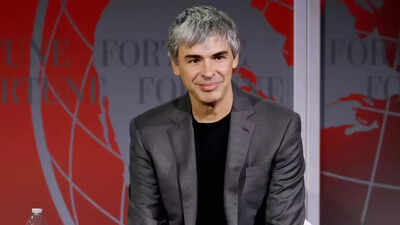
Quote of the day by Larry Page
For most corporate leaders, a 10% growth margin is a reason to celebrate. But for Larry Page, the co-founder of Google, such modest gains are a sign of failure. In a world defined by safe bets and strategic positioning, Page has built a global empire on a singular, audacious philosophy: ‘Crazy’ is the only way to succeed.
That’s what he said in 2013, when he was serving as the company CEO after taking the helm from Eric Schmidt. At that time, Google was focusing on integrating its services, launching major hardware and shifting toward mobile/social. The period was highlighted by the release of Google Glass, the Chromecast and the Nexus 5 smartphone. Speaking on his vision for the future of technology, Page offered a blunt assessment of modern ambition to Wired, saying that one can be only successful if he is doing crazy things.
Quote of the day by Larry Page
“If you’re not doing some things that are crazy, then you’re doing the wrong things.”
Takeaway: Quote of the day by Larry Page
As a CEO, Page’s approach was fundamentally different from the rest of Silicon Valley tech leaders. While competitors focus on “tweaking code” or finding “hidden efficiencies” to achieve incremental progress, Page expected his employees to build products and services that are ten times better than anything else on the market.According to Page, a 10% improvement simply means you are doing the same thing as everyone else, which for him, is not enough.
While that path might prevent a “spectacular failure,” Page believed that it also guarantees you will never “succeed wildly.” To achieve a 1000% improvement, one must rethink problems from the ground up, exploring the absolute limits of what is technically possible.
The logic behind Google X
To ensure the company never stops innovating and developing, Page established “Google X,” a secretive division dedicated to “moon-shot” projects like self-driving cars.
When asked why an entire department was necessary for these experiments, Page explained that while Apple might succeed by doing a very small number of things, he finds that approach “unsatisfying.” Page said that these projects are opportunities “to make people’s lives better.
” “We need to be doing breakthrough, non-incremental things across our whole business. But right now Google X does things that can be done more independently.
We always have these debates: we have all this money, we have all these people, why aren’t we doing more stuff?” he said.“You may say that Apple only does a very, very small number of things, and that’s working pretty well for them. But I find that unsatisfying. I feel like there are all these opportunities in the world to use technology to make people’s lives better. At Google we’re attacking maybe 0.1 per cent of that space.
And all the tech companies combined are only at, like, one per cent. That means there’s 99 per cent virgin territory.
Investors always worry, “Oh, you guys are going to spend too much money on these crazy things.” he added.“But those are now the things they’re most excited about — YouTube, Chrome, Android. If you’re not doing some things that are crazy, then you’re doing the wrong things,” Page noted.
From Michigan to the Moon
This “healthy disregard for the impossible” isn’t a new mindset for Page.
It began during his undergraduate years at the University of Michigan and followed him to Stanford. What started as a simple thesis idea to annotate web pages was “10x-ed” into a search engine that transformed the world. Once Google’s advertising business provided a comfortable financial cushion, Page pushed the boundaries even further.
- Gmail launched with 100 times the storage of its competitors.
- Google Books – a project to scan nearly every book ever published.
- Google Fiber that provides broadband speeds 100 times faster than the industry standard.
Page’s way of working made people excited
Page said that while investors often worry about “spending too much money on crazy things,” Page pointed out that the “crazy” projects of yesterday – such as YouTube, Chrome, and Android – are the very things investors are most excited about today.
However, Page warns that big ambition is becoming a rare commodity. He believed the current education system is failing to train people on how to pick projects that make a broad technological impact, choosing instead to focus on narrow specialisations.Despite recent scrutiny from regulators and critics regarding Google’s immense power, Page’s philosophy remains a beacon for optimists. To him, a car that drives itself is a more valuable “dividend” to humanity than any number on a share value statement.“It’s not easy coming up with moon shots. And we’re not teaching people how to identify those difficult projects. Where would I go to school to learn what kind of technological programmes I should work on? You’d probably need a pretty broad technical education and some knowledge about organisation and entrepreneurship. There’s no degree for that. Our system trains people in specialised ways, but not to pick the right projects to make a broad technological impact,” Page said.In Page’s view, the greatest threat to a company isn’t competition or legal battles – it is a lack of ambition.

