

Assuming an alter ego provides an “active” cognitive strategy for managing stress and adversity. This is famously known as the “Batman Effect.”
We will come to our inner superhero, Batman, in a short while. For now, let’s think for a moment about what’s on our minds. AI-related disruptions at the workplace moving at a pace we all cannot comprehend.
Fear of mass layoffs. Wars unfolding in real time, making distant crises feel immediate and personal. Why shouldn’t it? The whole world’s economic collapse seems imminent in the current scenario. No one goes unaffected. Then comes social media. The algorithmic architecture has been designed by the Big Silicon Valley Tech Bros. to maximize engagement (and their profit) through outrage and fear. These are just the big problems.Then comes the individual battles. The heat, the office politics, relationship woes, and caring for your children and elderly parents. We have gone past the stage where a human brain can function in a calm and collected way just for a day. Either we feel like zombies, moving from one task to another to tick checklists. Or, our brain goes on an overdrive. That’s what evolution taught homo sapiens. Our brains scan and anticipate, and then we try to problem-solve our way through life.
Every second of each day. It is but obvious that instead of producing clarity, our minds are spiralling into an overdrive that’s hard to come back from.

AI-related disruptions at the workplace moving at a pace we cannot comprehend. There’s fear of mass layoffs. Wars are unfolding in real time, making distant crises feel immediate and personal.
Voices in our head have superpowers
None of us are okay. Though psychologist and neuroscientist Ethan Kross has hope. Not the hope out of thin air we latch on to. This is hope with scientific proof. As one of the world’s leading experts on emotion regulation, Kross says, we all have a way out of this negative loop in our brain.
And that we can all feel calmer and far more positive if only we change how we talk to ourselves… you know, self-talk, or brain chatter, or what we all call “the voices in our head”.
Because the voices in our head were never really background noise. It was often misunderstood in previous centuries, and no one till the late 21st century ever realized that those voices are our superpowers – the most powerful cognitive tools we possess to survive in our increasingly chaotic world.
The world may not get better soon. But we can harness our minds to our benefit if we only try. And that can happen sooner than you think.
At last, some semblance of normality…
Our brain is a “Swiss Army Knife”
Now let’s try and understand how we can achieve this. To understand the good, it’s essential to know the bad. It goes like this: In moments of stress and uncertainty, our minds often turn against us, morphing into what Kross terms as “chatter”. This process overwhelms our brain’s finite attentional resources.
Remember, that the human mind was not made for consuming as much information (quantitatively and qualitatively) as we do currently.
It almost seems inevitable. And inescapable. If you want a better understanding on a physical plane of what “chatter” feels like – it’s like your brain has about 500 tabs open at the same time. Scientists call this “cognitive overload”.When those voices in our head say bad things to us, we are effectively training 86 billion neurons in our brains to believe it; by prioritizing circuits associated with anxiety and self-doubt. It’s a condition that degrades performance, fractures social relationships, and induces physical health decline through chronic stress signaling. This “chatter” is all the repetitive, negative thought loops that hijack our attention, distort our perception, and amplify all our fears:“I can’t do this anymore.”“I’m a failure.”“There is no going back from this.”Except, there is. The human inner voice isn’t abstract or fleeting – it’s a core biological process that shapes how the brain functions, organizes and re-organizes itself. Research by Kross at the University of Michigan describes this inner dialogue as a “Swiss army knife” of the mind. In essence, our minds are a multi-purpose tool. It helps us reflect on the past. At times, a lot.
Sort of in a loop. But it’s also capable of imagining a better future, and building a sense of self – all through positive self-talk.
We just have to change what we are saying to ourselves.

Either we feel like zombies, moving from one task to another to tick checklists. Or, our brain goes on an overdrive. That’s what evolution taught homo sapiens.
Brain is tricky but also mush. Rotate it to your benefit
Let’s take a deep dive. The physical brain is a malleable structure – pliable, flexible, and moldable. This characteristic of our brain is called “neuroplasticity”. Simply put, it allows our minds to reorganize its neural pathways depending on our thoughts.
Think of the same 86 billion neurons, except this time the dialogue we are having is positive and constructive. This activates the prefrontal cortex, the region responsible for emotional regulation and complex problem-solving.
So, start saying things like:“I can do this.”“I can overcome obstacles.”“Let’s think of solutions.”Our minds immediately start to reorganize the neural pathways to a positive direction.
The main thing to focus on over here is our internal monologue. Because this serves as one of the most frequent and consistent stimuli our brain receives. Kross says, the inner voice, at its best, is a remarkable instrument. It allows us to plan, simulate future scenarios, rehearse conversations, regulate behaviour, and construct meaning from our experiences.
It is the mechanism through which we tell ourselves who we are.
Neurons that fire together, wire together
Then comes the Hebb’s Rule—the principle that “neurons that fire together, wire together”—the repetitive nature of self-talk strengthens specific synaptic connections. Now, if we can change our habitual thought patterns to constructive ones consciously, these positive thought patterns become our default “neural highways”, and change our perception of reality. In a good way. In essence, this process, when consciously repeated, makes us feel happy and keeps us in a positive loop.
And as soon as that happens, we start approaching every question in our lives—big or small—in a solution-oriented way. The negative loop is broken.
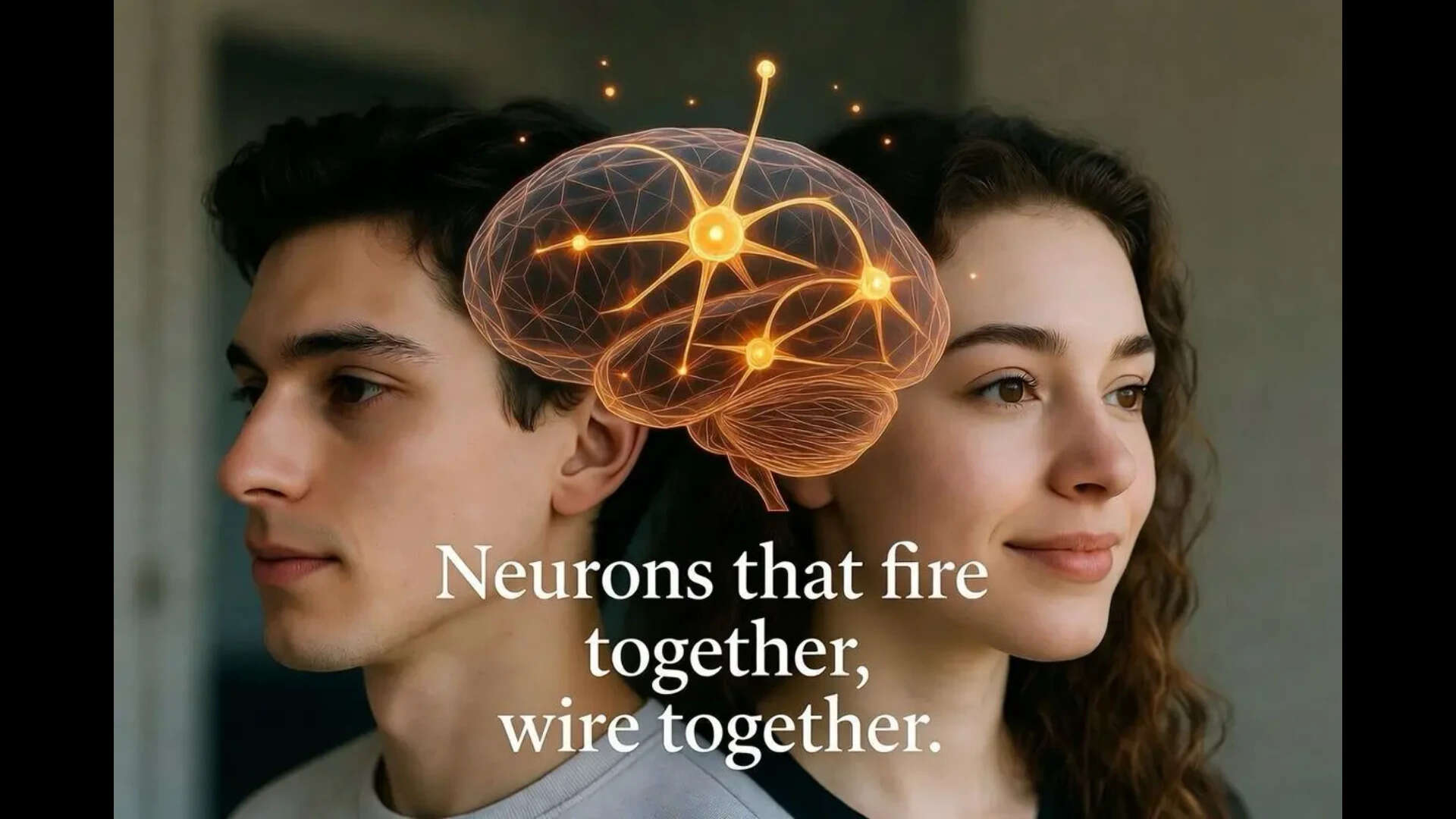
The repetitive nature of self-talk changes our habitual thought patterns to constructive ones. These positive thought patterns then become our default “neural highways”, and change our perception of reality. In a good way.
Ways to interrupt negative loops…
This is particularly relevant to our current moment. New research does not merely diagnose the problem; it offers a set of practical, science-backed tools that are strikingly accessible. The most powerful among them is deceptively simple: change the way you talk to yourself.
One of the key techniques is “distanced self-talk.” It goes like this: Instead of using first-person language—“Why am I feeling this way?”—we shift to using our own name or the pronoun “you.
” For example: “Why is [our name] feeling this way? What should we do next?” This small linguistic shift creates a psychological distance. It allows us to step outside the immediacy of our emotions and approach the situation as a third person.
You know, like when advising our friends we keep clarity and objectivity, which we fail to apply to ourselves? Distance-self talk is us talking to ourselves with the same clarity and objectivity.
King Solomon’s dilemma
This works because of a well-documented phenomenon often referred to as “Solomon’s paradox”. Let’s explain this in one line without taxing our brains too much. This article, after all, is all about doing just the opposite – relieving our minds of fluff.
Solomon, the king of ancient Israel, was adept at solving all his subjects’ problems but when it came to his own, he failed miserably. Hence, Solomon’s paradox is nothing but the tendency to think more wisely about others’ problems than our own.But here’s what matters. Solomon’s Paradox is not an inescapable trap. Studies have shown that when individuals are instructed to “self-distance”—to view their own dilemmas in the third person—the gap between their personal and interpersonal wisdom virtually disappears.
Batman has entered the neural fray
This is done by treating our lives like characters in a book. The irony here is that children naturally begin the process of thinking this way. But somewhere along the way, as we grow up, life gets in the way. For children and adults alike, assuming an alter ego (read your favourite superhero character from a comic book or movie or TV series) provides an “active” cognitive strategy for managing stress and adversity. This is famously known as the “Batman Effect,” a term derived from a study on children’s perseverance.

Building resilience in our times is all about regulating our inner voices – the deliberate act of pulling up our superhero ability to positively self-talk our way through life.
It says, when we are immersed in our own problems, our thinking narrows. Emotions run high, perspective shrinks, and reasoning becomes biased. But when we consider someone else’s situation, we are more naturally attuned to adopt a broader, more balanced view. Effectively, distanced self-talk is just tricking our brain into inward wisdom. Hah! That was easy.The management of “chatter” is also deeply influenced by our surroundings – the nature of the support system around us.
Think a close friend, a colleague-cum-friend, a sibling, maybe a parent – basically whoever you talk to in times of great need. Research says our minds are wired to seek validation and through it, find comfort. Now, while “venting” may fulfill an emotional need, even strengthen our bonds, it fails to decrease long-term distress or PTSD symptoms.
Did we talk about mass PTSD yet, post the Pandemic? If not, that’s another article, for another time.
For now, we go by what researchers found after major tragedies, accidents, university shootings etc. Students who shared their emotional pain online found comfort but did not experience a reduction of their pain in the long run. This is because our brains work in a peculiar way. When we are aware that we are being helped, it undermines our sense of “self-efficacy”—the belief that we are capable of managing our own challenges.
After Batman, comes Invisible Man powers
So, first find effective support. It comes from people who do two things: validate our emotions and then help us broaden our perspective. This distinction matters in today’s hyper-connected world, where digital platforms often encourage performative venting. Posting frustrations online may generate immediate empathy, but it rarely leads to constructive reframing. In fact, it can reinforce negative loops by keeping attention fixed on the problem.
What we need instead are “perspective partners”—people who can gently guide us out of the maze of our own thoughts. People who while helping us don’t make themselves the highlight; but give all the weightage to us in the form of support and guidance. Science calls this “invisible support”, where help is provided without drawing attention to it. Batman done, now the Invisible Man/Women has entered the frame with his/her nuanced and gentle support system.The next step to turning negative self-talk to positive one requires actual physical work. Like proactively completing household chores for a struggling partner without being asked. Creating a “quiet space” for someone to work without highlighting their perceived stress. Observing, and doing a basic kind deed is all it means. In your immediate surroundings. You don’t have to go far.
Get that “awe-some” perspective
This leads to what scientists call “perspective-broadening”.
And this too helps our minds to stay in the positive loop. Our physical environment provides tools for regulating our inner voices. Nature, specifically, functions as a powerful anti-aging elixir and therapist. According to Attention Restoration Theory, interacting with green spaces engages “soft fascination”—a type of involuntary attention that allows our neural pathways to recharge.Research conducted at Chicago’s Robert Taylor Homes revealed that residents with views of natural scenery demonstrated better attention, less procrastination, and more positive outlooks compared to those with views of gray, urban environments.
Even brief walks in a safe natural setting can evoke feelings of “awe”, which broaden perspectives and help us realize that those voices in our head are just a small part of a much larger world.

Traditionally, resilience has been framed as toughness – the ability to endure hardship without breaking. But modern science suggests a more nuanced definition. Resilience is not about suppressing emotion; it is about regulating it.
Flip the definition of resilience
What ties these three strategies together is a fundamental shift in how we understand resilience. Traditionally, resilience has been framed as toughness – the ability to endure hardship without breaking. But modern science suggests a more nuanced definition. Resilience is not about suppressing emotion; it is about regulating it. And how does one do it in our times?To keep our minds in a positive loop, we must make sure we outsource just tasks and not our whole process of thinking to AI. When we rely too heavily on external systems to process emotions, we weaken our ability to peek within and think for ourselves. In time, the inner voice, instead of being trained, becomes neglected. So building resilience in our times is all about regulating our inner voices – the deliberate act of pulling up our superhero ability to positively self-talk our way through life.