
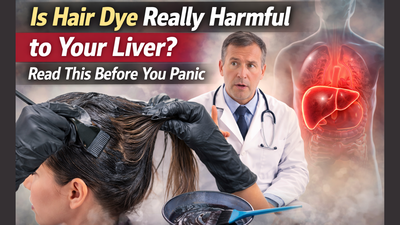
You’re standing in the salon chair, watching your hair transform, and a thought creeps in: Is this stuff actually toxic? The chemicals smell strong, and you’ve probably heard stories about hair dye causing liver failure.
So what’s actually true?Dr. Chetan Kalal, a hepatologist and liver transplant physician at Saifee Hospital, puts it plainly: “There is no significant clinical evidence that routine use of cosmetic hair dyes can cause progressive liver disease in the general population.” The reason is straightforward. Most commercially available dyes are regulated, and your scalp doesn’t absorb much of what you apply. The systemic absorption is low, meaning the chemicals aren’t getting deep into your bloodstream in quantities that would harm your liver.
That said, it’s not completely risk-free
There have been occasional case reports of liver damage after using hair dye, usually involving a chemical called para-phenylenediamine, or PPD. But here’s what matters: these reactions are idiosyncratic—unpredictable and unique to certain people. They’re not dose-dependent, meaning more dye doesn’t increase risk. And they’re not a public health pattern. They’re rare exceptions.The real concern isn’t hair dye alone. It’s what happens when you stack multiple risks on top of each other.
Dr. Harshil S. Shah, a consultant in GI, HPB and liver transplant surgery at Bhailal Amin General Hospital, explains that certain chemicals like PPD and ammonia can cause toxicity if they’re absorbed systemically, either through damaged skin or by inhaling fumes during application. Most reactions are skin allergies, which are uncomfortable but not dangerous. The documented cases linking hair dye to acute hepatitis involve repeated or prolonged use, usually in people already dealing with other health issues.
And that’s where smoking becomes the real issue
Smoking is an independent risk factor for liver harm—it causes oxidative stress, inflammation, and fibrosis, all contributors to liver disease, especially if you’ve got fatty liver or a drinking history. When someone smokes and is exposed to chemical agents like hair dye, the cumulative toxic burden increases. But Dr. Kalal’s priority message is clear: “Smoking cessation is a much stronger intervention to help liver health than not using hair dye.
“In other words, if you’re concerned about your liver health and you smoke, quitting smoking will protect your liver far more than giving up hair dye ever would.
So what should you actually do?
The safest approach is practical common sense. Choose hair dyes from reputed, regulated brands that meet safety standards. Those ammonia-free or “herbal” options aren’t automatically safer—they just contain different chemicals, and some of those can still cause problems in certain people.Do a patch test before each application. This catches hypersensitivity reactions before you color your entire head. Never apply dye to broken, inflamed, or irritated scalp—damaged skin absorbs chemicals more readily. Wear gloves and ensure good ventilation to minimize inhaling fumes. Don’t go overboard with frequency. Space out applications according to recommended intervals and never leave dye on longer than instructed.If you have a pre-existing liver condition—fatty liver, hepatitis, cirrhosis—talk to a doctor first. Your liver’s already compromised, so the risk changes. You’re more vulnerable, and it’s worth being cautious.The reality is that serious liver injury from hair dye is genuinely rare. But it’s not impossible, and precautions are straightforward. Use dye safely, follow instructions, and if you smoke, make quitting your priority.
That’s where the real difference happens.Medical experts consulted This article includes expert inputs shared with TOI Health by: Dr. Chetan Kalal, hepatologist and liver transplant physician at Saifee HospitalDr. Harshil S. Shah, consultant in GI, HPB and liver transplant surgery at Bhailal Amin General HospitalInputs were used to explain the link between hair dye use and risk of liver damage.